Founder, Executive Thinking Institute™
Behind every institution is a vision. Discover the business experiences, leadership philosophy and purpose that inspired the founding of Executive Thinking Institute™ and its commitment to developing better business leaders.

MARCUS GOH
Founder, Executive Thinking Institute™
Creator of ETBSS™ and O₂CEO™
The Founder Behind
Executive Thinking Institute™
Marcus Goh is the Founder of Executive Thinking Institute™ and the creator of ETBSS™ and O₂CEO™. With more than 30 years of experience spanning sales, marketing, business development and leadership, he has built businesses, led teams and worked with organisations across multiple industries.
His career has provided first-hand insight into a recurring challenge: many capable professionals are promoted into leadership roles without developing a holistic understanding of how businesses truly operate.
This realisation led to the founding of Executive Thinking Institute™, where practical business simulation and experiential learning are used to develop stronger commercial thinking, executive capability and better business decision-making.
A Career Built From the Ground Up
Marcus began his career in 1995 as a fresh graduate with no formal sales experience and limited understanding of what a professional sales career involved.
Starting on the frontline, he learned through direct customer engagement, rejection, persistence and continuous improvement. He developed the ability to understand customer needs, communicate value, build trust and remain resilient in challenging commercial environments.
What began as an unfamiliar entry-level sales role became the foundation of more than three decades of experience across sales, marketing and management. Over the years, Marcus progressed from individual sales responsibilities into market development, commercial operations, team leadership, business ownership and regional business building. His journey shaped a strong belief that meaningful capability is rarely developed through theory alone. It is strengthened through practice, feedback, responsibility and real consequences.
Learning Within Established Organisations
Before becoming an entrepreneur and business builder, Marcus worked with several multinational corporations and established businesses.
These roles exposed him to structured sales systems, marketing operations, customer development, commercial planning, team management and organisational performance. Working within larger organisations also helped him understand the importance of:
Clear Business Processes

Disciplined Execution
Customer & Market Understanding

Performance Accountability

Teamwork Across Departments
Strategy & Operational Delivery Alignment
This corporate foundation later became valuable when Marcus moved into entrepreneurship and regional business development.
Experiencing Entrepreneurship First-Hand
Marcus later established and operated his own business.
This gave him first-hand responsibility for the realities of entrepreneurship, including sales, marketing, pricing, inventory, cash flow, operations, customer acquisition, team management and business expansion. The experience also brought difficult but important commercial lessons.
During the growth of the business, expansion moved faster than the underlying commercial viability and financial returns justified. The experience reinforced that revenue growth, physical expansion and increased business activity do not automatically create sustainable value.
Sustainable growth requires leaders and business owners to carefully evaluate:
Profitability

Cash Flow
Operational Capacity
Working Capital
Resource Commitments
Market Demand
Commercial Viability
Return on Investment
This period became one of the most important influences on Marcus’s approach to business education.
It taught him that poor business decisions are not always caused by a lack of intelligence or effort. They often happen because leaders and entrepreneurs have not been given sufficient opportunities to understand how different business variables interact before making high-impact decisions in the real world.
From a One-Person Operation to Multi-Million-Dollar Businesses
Building on his earlier experience, Marcus subsequently established two regional business entities for a global brand — one in Singapore and one in Malaysia—from the ground up. He began as a one-person operation, personally taking responsibility for developing the markets, building customer relationships, managing commercial activities and establishing the operational foundations of both entities. Over time, Marcus recruited and developed teams, expanded the businesses and grew both operations into multi-million-dollar businesses.
Market entry and business development
Sales and marketing
Commercial planning
Operational management
Team recruitment and development
Financial management
Customer and channel development
Regional growth
Business expansion.
This experience gave Marcus direct exposure to the full business-building journey—from starting with limited resources to developing functioning teams and commercially established operations across two markets. It also strengthened his understanding that successful growth requires both ambition and discipline. Leaders must recognise opportunities while remaining realistic about profitability, cash flow, operational readiness, competitive conditions and long-term sustainability.
A Broader Perspective on How Businesses Operate
Marcus’s career has allowed him to experience business from several perspectives. These experiences gave him a practical understanding of the challenges faced by employees, managers, entrepreneurs and business leaders at different stages of their development.
As a fresh graduate entering sales with no formal experience;
As a frontline salesperson learning directly from customers;
As a professional within multinational and established organisations;
As an entrepreneur operating his own business;
As a manager responsible for people and performance;
As a regional business builder establishing operations from scratch; and
As a trainer and programme creator developing others.
"Business success depends not only on knowledge or hard work, but on the quality of decisions made across strategy, finance, marketing, operations, people and growth."
Bridging the Gap Between Knowledge and Business Reality
Throughout his career, Marcus observed that many capable professionals, managers and aspiring entrepreneurs work hard without always having access to practical business guidance or opportunities to understand how business decisions affect performance. Many professionals become highly competent within their own functions but receive limited exposure to how an organisation operates as an interconnected business system.
Aspiring entrepreneurs may learn individual concepts such as marketing, finance or strategy, yet still lack the opportunity to experience how these disciplines interact when running an actual business. Managers and leaders face a similar challenge. As their responsibilities increase, technical expertise alone becomes insufficient. They must evaluate trade-offs, allocate resources, think across functions and make decisions that support wider organisational performance.
Marcus founded the Executive Thinking Institute™ to address this gap. ETI was created to help participants move beyond understanding business concepts towards applying them in realistic, integrated and decision-based environments.
Why Traditional Business Learning Was Not Enough
Before building and operating businesses, Marcus invested in business courses, workshops and learning programmes to strengthen his understanding of entrepreneurship and management. Many of these programmes provided useful theories, concepts and frameworks.
However, few gave participants the opportunity to experience:
How business decisions interact
How financial and operational trade-offs emerge
How market conditions affect performance
How cash flow constrains growth
How pricing affects demand and profitability
How expansion decisions create risk
How leadership choices affect execution
How one decision can create consequences across the entire business
Marcus discovered that knowing what a business concept means is very different from applying it under uncertainty. This became one of the main reasons he chose to build ETI around business simulation, experiential learning, performance feedback and structured reflection rather than lectures alone.
Turning Experience Into Practical Development
Marcus created ETI not simply to teach business concepts, but to help others avoid learning every lesson through expensive trial and error.
Having experienced both business growth and difficult commercial consequences, he is committed to helping aspiring entrepreneurs, professionals and organisational leaders develop the business understanding and judgement he wished he had acquired earlier in his career.
His goal is to provide participants with a practical environment where they can:
Test decisions
Evaluate trade-offs
Experience consequences
Recognise weaknesses
Challenge assumptions
Improve judgement
Build confidence before facing similar responsibilities in the real world
Marcus believes that people grow most effectively when they are given the opportunity to practise, reflect and improve—not merely listen and remember.
Capability Is Developed Through Experience
Marcus believes that effective business and leadership development should strengthen judgement, not merely increase information. His learning philosophy is built around a continuous cycle:
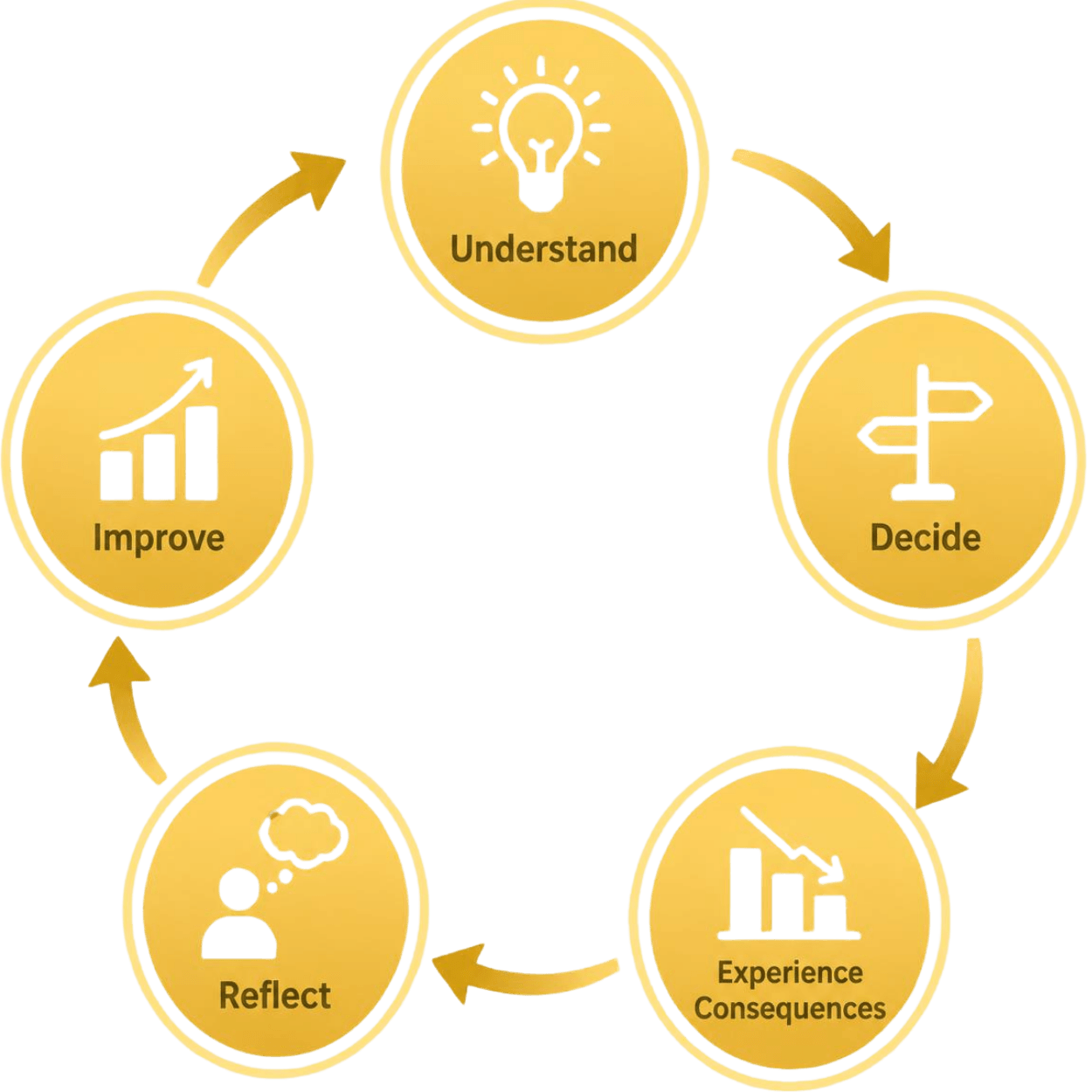
Participants should not simply be told what a strong decision looks like. They should be placed in realistic situations where they must:
Interpret information
Assess competing priorities
Manage limited resources
Make choices
Observe outcomes
Reflect on what should be improved
This approach helps learners develop a deeper understanding of how different business functions interact.
It also makes performance more visible. Rather than relying only on attendance or theoretical assessments, simulation-based learning can provide meaningful insights into decision quality, business understanding and capability development.
Bridging Theory, Application and Judgement
ETI was built around four common development gaps, and ETI’s simulation-based approach was created to address these gaps.
Knowledge Without Application
Many programmes explain business principles but provide limited opportunity to apply them within an integrated decision-making environment.
Functional Expertise Without Business Perspective
Professionals may understand their own departments well without fully appreciating how their decisions affect finance, customers, operations and wider organisational performance.
Experience Without Structured Reflection
Real-world experience can be valuable, but important lessons are not always recognised without purposeful feedback, assessment and reflection.
Decisions Without Safe Practice
Entrepreneurs and leaders often learn through costly trial and error because they have few safe environments in which to practise complex business decisions.
ETI’s simulation-based approach was created to address these gaps.
Two Distinct Learning Ecosystems
Marcus developed two programme ecosystems to serve different audiences while applying the same philosophy of experiential, simulation-based learning.
ETBSS™
(Executive Thinking Business Simulation System™)
ETBSS™ is designed for organisations seeking to strengthen leadership capability, commercial awareness, cross-functional understanding and business judgement across different levels of management. Its learning pathways support leadership development at three levels:
LeadEx™ → ScaleEx™ → MasterEx™
ETBSS™ helps organisations develop emerging leaders, managers and senior leadership teams through realistic business simulation, decision-making and performance assessment.
O₂CEO™
(Zero to CEO Entrepreneur Leadership Program™)
O₂CEO™ is designed for individuals who want to understand how businesses operate and strengthen entrepreneurial thinking, commercial awareness, leadership capability and decision-making confidence. Its learning pathways serve participants at different stages of business, professional and leadership development:
StartX™ → GrowthX™ → VisionX™
O₂CEO™ allows participants to experience the realities of managing a business in a structured, practical and risk-controlled environment.
Experience That Informs the ETI Approach
Marcus combines business ownership, regional business development, management education and adult-learning capability in the design and delivery of ETI programmes.
Over Three Decades of Experience
More than 30 years of experience across sales, marketing and management, beginning in 1995.
Multinational and Corporate Exposure
Experience working within multinational and established organisations, gaining exposure to commercial operations, market development, customer management and structured business environments.
Entrepreneurship and Business Ownership
First-hand experience establishing and operating his own business, including managing sales, marketing, inventory, operations, cash flow and expansion.
Regional Business Building
Established and grew two regional entities for an international mattress brand in Singapore and Malaysia, developing them from one-person operations into teams and multi-million-dollar businesses.
Management Education
Holds a Master’s Degree in Management, supporting his understanding of strategy, organisational performance and management practice.
Training and Assessment
A Certified Trainer and Assessor (ACTA) with experience in adult learning, facilitation and translating complex business concepts into practical learning experiences.
Programme Development
Creator of the ETBSS™ and O₂CEO™ business simulation frameworks, their progressive learning pathways, performance assessments and professional credential architecture.
Published Author
Author of 'The Secret Scroll of Sales Mastery: Ultimate Sales Success – Timeless Secrets Revealed', bringing together practical sales experience, commercial insights and approaches developed through nearly three decades in sales, marketing and business leadership
Certified Coach
Certified through the International Coaches Register (ICR), Marcus incorporates coaching-based questioning, reflection and development approaches into selected ETI learning experiences.
Capabilities That Matter Beyond the Classroom
The purpose of ETI programmes is not simply to help participants know more. It is to help them think and decide more effectively.
Business Understanding
See how strategy, finance, marketing, operations and leadership work together.
Commercial Awareness
Understand the drivers of revenue, profitability, cash flow and sustainable value creation.
Strategic Thinking
Evaluate long-term implications, competing priorities and business trade-offs.

Business Judgement
Make more balanced decisions when information is incomplete and outcomes are uncertain.
Cross-Functional Perspective
Move beyond departmental thinking and consider the wider organisational impact of decisions.

Leadership Confidence
Develop confidence through application, performance feedback and realistic decision-making experience.
Successes, Challenges and Practical Judgement
Marcus’s approach is shaped by both business achievements and difficult commercial lessons. Building regional operations from the ground up taught him how markets are developed, teams are created and businesses are scaled. Operating his own business taught him that growth without disciplined viability assessment can create financial and operational pressure.
Working within established organisations showed him the value of structure, process and accountability. Starting his career without sales experience taught him that capability can be developed through persistence, practice and continuous improvement.
Together, these experiences shaped the core principles behind ETI:
Capability is developed through practice;
Decisions should be evaluated beyond short-term outcomes;
Growth must be supported by commercial viability;
Leaders must understand the business beyond their own functions;
Reflection turns experience into learning; and
Business judgement improves when people can see the consequences of their decisions.
A Message From Marcus
“I created the Executive Thinking Institute because I believe too many capable people are expected to make important business and leadership decisions without ever having had the opportunity to practise them. I began my own career as a fresh graduate with no formal sales experience. Over the following three decades, I worked across sales, marketing and management, operated my own business and built regional business entities from the ground up.
Along the way, I experienced both growth and difficult commercial lessons. These experiences taught me that knowledge alone does not remove uncertainty, balance trade-offs or guarantee sound judgement. Business and leadership capability must be developed through application, consequences, reflection and experience. Through ETBSS™ and O₂CEO™, my goal is to provide participants with a realistic environment where they can test decisions, understand outcomes and strengthen the thinking required to lead businesses, teams and organisations more effectively. It is better to discover the impact of a poor decision in a simulation than through an expensive mistake in the real world.”
— Marcus Goh
Founder, Executive Thinking Institute™
Building a Stronger Culture of Executive Thinking
Marcus’s long-term vision is for ETI to become a trusted platform for practical business, leadership and executive capability development. The institute aims to support:
Individuals seeking stronger business understanding;
Fresh graduates preparing for the workplace;
Professionals aspiring to greater responsibility;
Entrepreneurs developing practical business judgement;
Managers strengthening commercial and strategic capability;
Organisations developing leadership pipelines;
Institutions seeking experiential business learning; and
Partners committed to developing future-ready talent.
ETI’s ambition is not to produce participants who can simply repeat business frameworks. It is to develop people who can interpret complexity, evaluate consequences and make better decisions.
Beyond Executive Thinking Institute
In addition to founding Executive Thinking Institute™ (ETI), Marcus Goh is also the Founder of Premier Success Coaching™ (PSC), where he works with business owners and leadership teams through executive coaching, organisational diagnostics and business consulting.
Together, ETI and PSC provide organisations with both capability development and practical implementation support.
Executive Thinking Institute™ equips professionals and organisations with practical business capability through experiential learning and business simulation. Premier Success Coaching™ complements this by providing executive coaching, business diagnostics and consulting to help organisations translate learning into sustainable business results.
In short, ETI develops capability. PSC helps organisations apply it.
Explore the Programmes Behind the Vision.
Discover how ETI’s simulation-based learning pathways develop business understanding, commercial awareness, strategic thinking and leadership capability for individuals and organisations.
Signature Programs
Integrated Solutions
A Division of Executive Thinking Asia Pte Ltd
60 Paya Lebar Road
#06-28 Paya Lebar Square
Singapore 409051
Email: support@execthinking.com
*Executive consultations and programme discussions are arranged by appointment, either virtually or at your preferred location.
Executive Thinking Institute™ © Copyright 2026